
“The function of science fiction is not always to predict the future but sometimes to prevent it.”
Frank Herbert
There’s a specific kind of rush that comes from watching a cheap, gleefully trashy B-movie and realizing it understood your country better than the experts did. That’s the experience of watching Death Race 2000 in 2026.
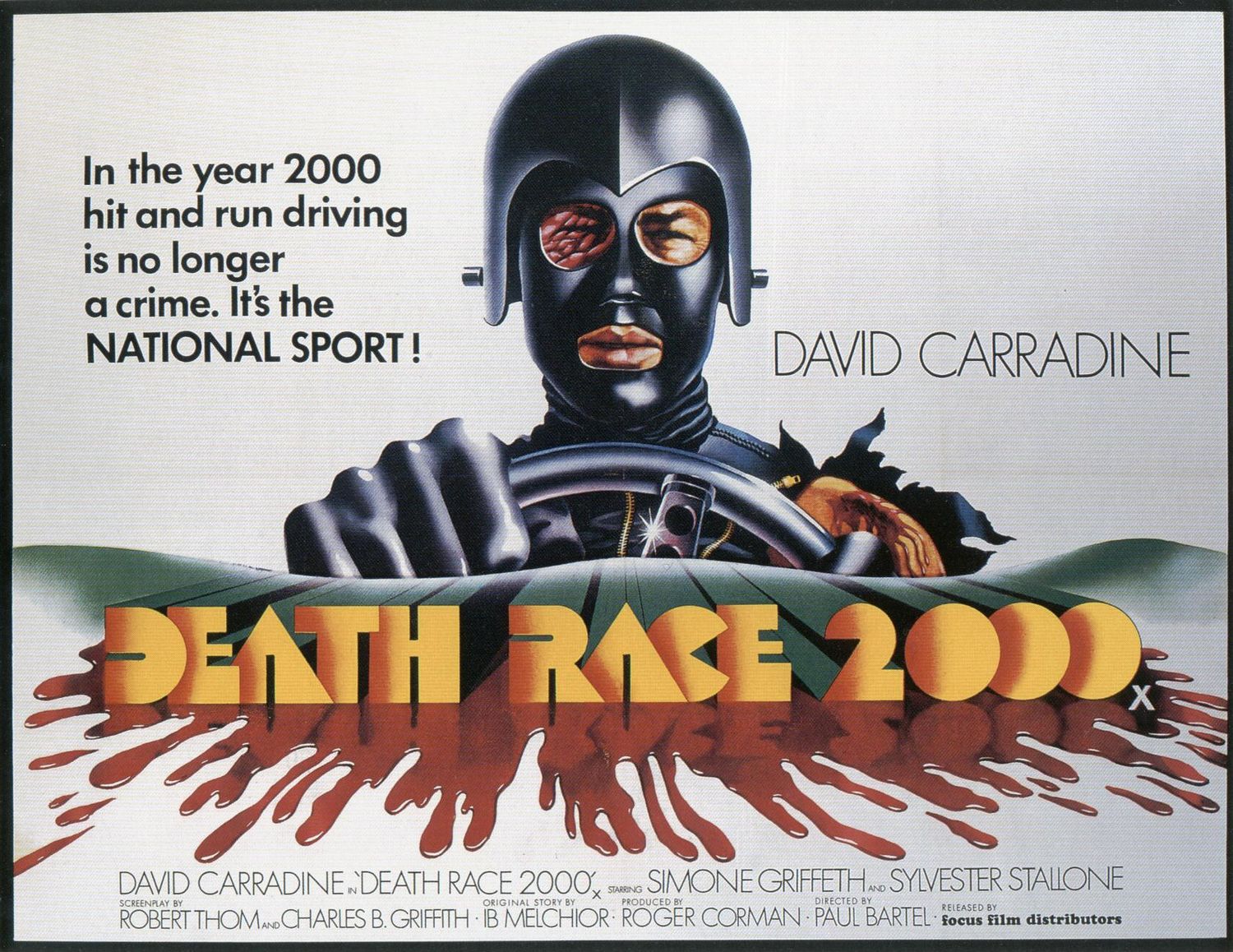
Produced by Roger Corman, directed by Paul Bartel, and written by Robert Thom, Charles B. Griffith, and Ib Melchior all the way back in 1975, on a budget that couldn’t have covered catering on a modern superhero movie, Death Race 2000 was made, quite openly, as a joke — a Vietnam-and-Watergate hangover cartoon about a fascist America that runs a cross-country demolition derby to keep the masses too entertained to notice they’re being governed by lunatics. Nobody involved thought they were making a documentary. And yet here we are, fifty-one years later, watching a movie about a media-savvy strongman who keeps a broken country distracted with spectacle, and it doesn’t play like satire anymore. It plays like Fox News.
And it’s not really a story about one uncanny prediction. It’s a story about what happens when a satire is built out of the actual load-bearing structures of American power rather than the cosmetic details of one administration. Nixon isn’t in Death Race 2000. Neither is Trump. What’s in it is the machine — and the machine, it turns out, doesn’t change nearly as much over the years as we’d like to think it does. New paint job, same chassis, still running people over.
The Race as Government
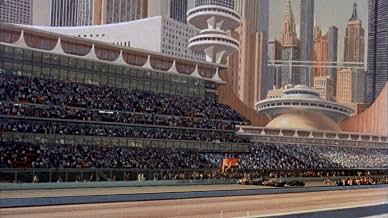
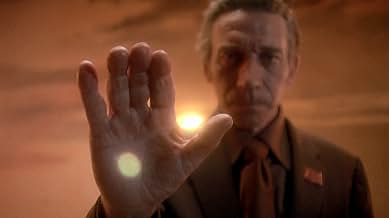
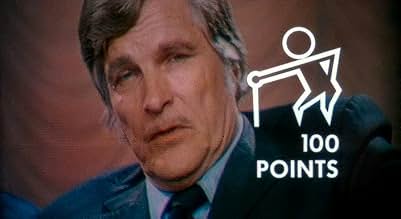
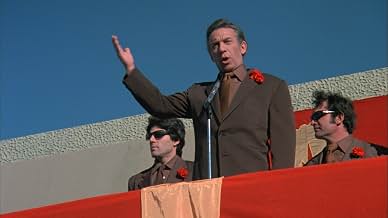
The premise is almost too on-the-nose to need explaining: a transcontinental road race, broadcast live, in which drivers score points by running down pedestrians. It’s staged by a “Mr. President” who has replaced governance with media spectacle. There’s no policy in this movie, no legislature doing anything recognizable as legislating. There’s only the race, and the race is the state’s relationship to its people — not “bread and circuses” as a metaphor, but bread and circuses as the literal, entire operating system of the country.
What’s chilling about that premise now isn’t the violence. (And, oh boy, is there a lot of violence. And nudity. And sex. Welcome to ’70s cinema, kids — they didn’t have streaming, so they had to get their kicks at the drive-in.) It’s the substitution. Civic life in the film hasn’t been suppressed so much as replaced by something more entertaining, and the public has made that trade willingly.
Today, we recognize the trade. We’ve watched governance itself become a genre of programming — a 24-hour content stream optimized for engagement rather than outcomes, where the news cycle and the entertainment cycle are functionally the same cycle. The film’s cynicism wasn’t that people would be forced to accept spectacle instead of self-government. It’s that, given the choice, they’d pick the spectacle every time and ask for a rewatch.
The Press Pool, Not the Fourth Estate
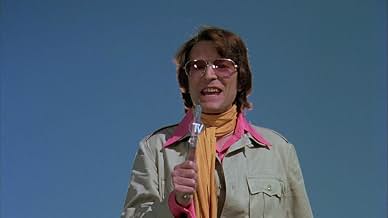
The detail from the film that ages the worst — worst for us, best as prophecy — is the treatment of the press. The journalists covering the race aren’t investigating anything. They’re narrating it, hyping it, humanizing its most brutal competitors, converting death into a leaderboard update. And when one of them accidentally reports the truth and gets “corrected” by a government official, watch how fast they fall back in line — no fight, no follow-up question, just a smile and an on-brand pivot back to the highlights. They function less like reporters than like a broadcast booth: dependent on access, invested in the show’s success, and allergic to anything that might get their credentials pulled.
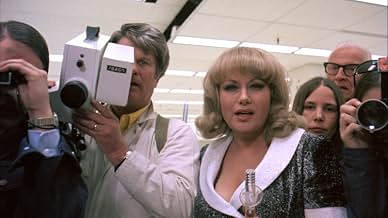
That’s not a dated 1970s gag about network news. It’s an almost clinical description of a media environment that has since organized itself around ratings, algorithmic engagement, and proximity to power rather than adversarial scrutiny. A press corps that needs the spectacle to keep running has a structural incentive to keep the spectacle sympathetic — to cover the horror as content rather than as accountability. Death Race 2000 predicted the economic logic that would eventually make “coverage” and “promotion” impossible to tell apart.
The Casual Normalization
All the drivers in the race are cartoon characters — think Wacky Races with a body count — built to be instantly recognizable types. But one stands out.
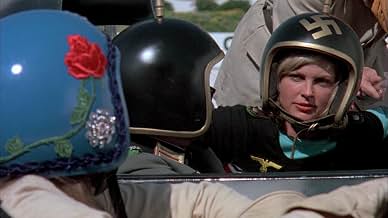
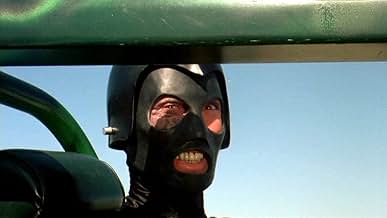
Matilda the Hun is a driver whose Nazi imagery the film treats as simply part of the roster, applauded by the crowd right along with everyone else. It’s a throwaway detail in the plot, and honestly not all that unusual for the era — kids, ask your grandparents about the sheer volume of comedic Nazis on TV and in movies through the ’60s and ’70s. But viewed with 2026 eyes, it becomes one of the most disturbing choices in the film, precisely because nobody makes a speech about it. Nobody in the crowd flinches. That’s the joke, and it’s a cruel one: extremist iconography, once it’s folded into entertainment and given a fanbase, stops registering as extremist. It just becomes another character with merchandise.
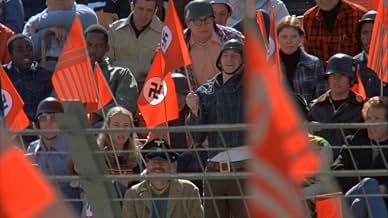
We’ve watched a version of that normalization play out for real — symbols and rhetoric that would once have been disqualifying, folded into the ordinary texture of media coverage, treated as one more flavor of content rather than a moral emergency. (Hey, there were “very fine people on both sides,” right? Right?) The film’s crowd doesn’t rise up against Matilda the Hun. They cheer. That’s not a prediction about ideology so much as a prediction about audiences — about how quickly outrage curdles into content fatigue, and how entertainment will absorb almost anything as long as it’s packaged as competition.
Blaming the World
The film’s isolationism gets less attention than its violence, but it’s doing real work. Mr. President blames France for the country’s collapsing infrastructure and economic decline — an absurd, arbitrary villain, chosen because a foreign scapegoat is a lot more useful to a regime than an honest accounting of its own failures. It’s the same move behind any “America First” framing: turn inward, treat international cooperation as a con being run against you, and swap out diplomacy for grievance. France, as usual — “Freedom Fries” anyone?.
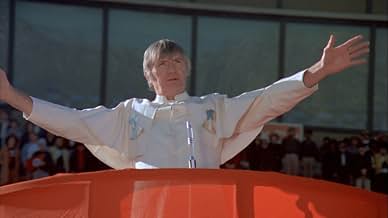
Death Race 2000 wasn’t making a serious argument about foreign policy. It was making a joke about how convenient it is for a failing government to have someone else to point at. The joke doesn’t land as absurd anymore. It just sounds like Tuesday.
Performative Resistance
The film does have a resistance movement, led by a woman named — no, seriously — Thomasina Paine. And it’s telling that the movie can’t quite bring itself to treat them as heroes. Their sabotage plays as slapstick, their planning as half-baked, their whole operation less “revolution” than community theater with worse blocking. That’s the point: the government doesn’t need to crush this resistance, because it’s already been rendered harmless by its own ineffectuality — and by a state media apparatus that’s happy to blame every act of sabotage on “French terrorists” or wave it off as the work of the lunatic fringe. Either framing does the same job. It keeps the audience at home from ever taking the opposition seriously enough to join it.

Paul Bartel wasn’t just mocking rebels for being bad at rebelling. He was making a nastier point: that a society this thoroughly hypnotized by spectacle doesn’t actually want the resistance to succeed, because success would mean the race stops, and the race is the only thing anyone still cares about. The crowd’s cheering isn’t passive. It’s complicity. Even the people fighting the regime can’t out-compete the entertainment value of the regime itself.
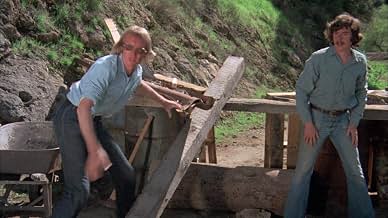
Sound familiar? Today it feels a little too on-the-nose that anyone who pushes back against power gets filed under “domestic terrorist” — or, the more efficient insult, simply ignored as an idiot not worth debating.
And the Audience Doesn’t Care Why
Underneath all of it is the detail that ties the whole film together: nobody in it seems to want an explanation. Not the crowd, not the press, not most of the drivers. They want the next lap. That contempt for inquiry — for asking why society is like this, why the economy collapsed, why the race exists at all — is its own kind of authoritarianism, one that doesn’t need to silence questions because the audience has stopped asking them. Anti-intellectualism, in the film’s world, isn’t a policy. It’s a culture. It’s what’s left over once spectacle has fully replaced explanation, and nobody notices the explanation is gone.

In our world, we’ve got a country where a healthy chunk of the population cheers the leader on no matter how self-serving, ridiculous, or flatly malignant he gets. Where the leader feeds off the adoration at rallies and the likes on his own self-published social media platform, and his fans feed right back off every bit of “winning” he tells them they’re experiencing — no receipts required, no questions asked. It’s not a policy debate anymore. It’s a fandom.
Why a Nixon Satire Still Fits Our Times
None of this means the filmmakers foresaw Trump specifically — they weren’t oracles, they were broke guys with a camera and an attitude. What they fed into their satire machine wasn’t Nixon the man; it was the apparatus around him: an imperial presidency, a credibility-shattered government, a country exhausted by an unpopular war and a corrupt administration, and a media system already learning that scandal and spectacle drew bigger numbers than substance. That apparatus didn’t disappear when Nixon resigned in disgrace. It went dormant, got rebuilt, got more efficient, and came roaring back online decades later wearing different branding and a much louder microphone.
That’s the real reason Death Race 2000 feels less like a period piece in 2026: it was never really about a specific president at a specific moment. It was about the conditions that manufacture presidents like that — a public trained to prefer the show, a press that profits more from broadcasting than investigating, and a politics organized around who can perform outrage and charisma the most entertainingly.
Change the decade, change the man in the compound, and the race keeps running. That’s not a coincidence. That’s the system working exactly as designed — and fifty-one years on, it’s still got a full tank of gas.
All images ©New World Productions


Leave a Reply